Table of Content
RGB LED Strip Controllers and Amplifiers: Compatibility Guide
When ordering an RGB LED strip system, match the strip, controller, amplifier and power supply as one bill of materials. Start with the exact product ratings and the planned layout, then confirm a model-specific connection drawing before installation.
Y&T Technology Development Co.,Limited. has focused on LED lighting, especially standard and custom LED strips, since 2012. Send the strip models, lengths and control requirements for a project quotation.
Request an RGB LED strip system quotation
1. Identify the strip and control system
An analog RGB system controls red, green and blue channels together along a connected section. The remote interface, such as IR or RF, and the electrical output are separate specifications: the remote alone does not identify a compatible strip or amplifier. Addressable strips use a different control architecture; see our LED control IC guide.
For a common-anode analog design, terminals may be marked V+, R, G and B. Confirm the actual polarity and terminal functions in all device manuals; wire colors and connector shapes are insufficient. RGBW adds a white channel, while RGB+CCT adds two white channels. Confirm the controller’s supported operating mode and channel count for the selected strip.
The Sunricher receiver manual illustrates why a model and version matter: it distinguishes constant-voltage and constant-current versions and specifies channel functions. This is a technical reference, not a claim that every controller we quote uses that design.
2. Compare the exact components before ordering
| Component | Details to confirm |
|---|---|
| LED strip | Input V DC; analog or addressable control; RGB, RGBW or RGB+CCT channels; rated W/m; finished width; cut interval; installation length and permitted run. |
| Controller | Supply range and output type; terminal polarity; supported channel mode; maximum current per channel and total; remote or control-system compatibility. |
| Amplifier / repeater | Input signal type; compatible voltage and channels; current limits; required supply and reference arrangement; approved signal distance. |
| Power supply | Exact output voltage and operating mode; available load at the planned temperature and mounting conditions; applicable model manual and project documents. |
| Cable and connectors | Current capacity, conductor size, terminal limits, cable length, connector pin order, physical fit and installation environment. |
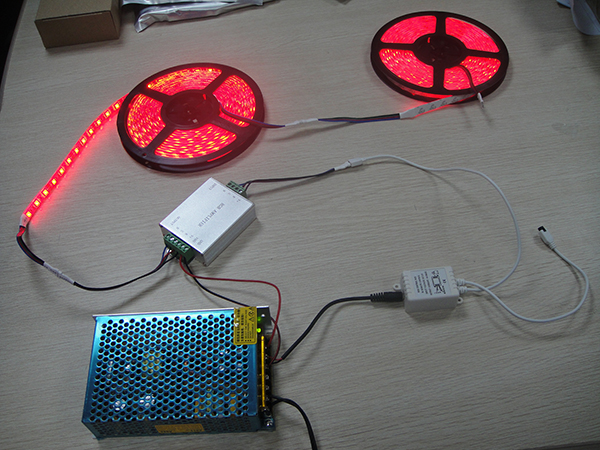
A PWM repeater receives a compatible control signal and drives an additional load from its specified power input. It does not create power or automatically increase the permitted length of a strip section. The Sunricher repeater manual shows the distinct control, supply and load connections for its own models; use the manual for the actual quoted device.
3. Estimate loading, then check every current limit
For preliminary budgeting, strip power equals rated W/m multiplied by installed metres. Nominal input current equals that power divided by rated DC voltage. Add controller and accessory consumption, then apply the power supply manufacturer’s loading and derating requirements. Cable losses and permitted feed positions need a separate layout check.
Example using a published model rating: our 24 V RGB COB strip, 840 LED/m, 10 mm, 15 W/m gives 15 W/m × 5 m = 75 W and 75 W ÷ 24 V = 3.125 A nominal total input current. This is an arithmetic estimate from the published rating, not a measured sample result or a complete power supply selection. Do not divide the total by three and assume that result is an approved current rating for every color channel.
The MEAN WELL FAQ discusses conductor current capacity, voltage drop and supply selection. Check the chosen supply’s derating curve and the controller’s per-channel and total limits. A larger power supply does not increase a controller’s current rating.
4. Confirm the project drawing and environment
Ask for a drawing that names the strip, controller, amplifier, power supply, cable lengths, feed points and branch protection. Where multiple supplies are proposed, require an approved signal-reference and power arrangement. Do not join their outputs unless the exact supply specifications explicitly support the intended parallel operation; the manufacturer’s parallel-operation guidance is model-dependent.
Installation must follow the actual device manuals and local requirements. Isolate power before work; mains connections and protective earthing belong with a qualified installer. The MEAN WELL LED power supply installation manual explains supply-specific installation and thermal conditions. Confirm environmental protection for the complete assembly, including controllers, joints and cable exits.
5. Send a complete quotation request
Tell us the strip model or desired lighting result, quantity and length of each section, supply voltage, controller or remote model, required functions, cable distances, installation environment, destination country and required dispatch date. Attach existing drawings or device manuals through our Contact form. If parts have already been purchased, include their complete model numbers and terminal labels.
Compare the current RGB COB model, RGBW COB model and RGB+CCT COB model, or discuss custom LED strip requirements. These are different channel configurations, not interchangeable replacements. Controller and accessory selection is confirmed in the quotation.
Our confirmed warranty policy is five years for LED strips, including custom strips, and three years for power supplies and accessories. Confirm the selected configuration, operating conditions, included documents and delivery schedule in the quotation. Dispatch timing and transport time are separate.
Request an RGB LED strip system quotation
6. RGB controller and amplifier FAQ
Is every IR remote control compatible with an RGB LED strip controller?
No. Confirm the supported remote model and command compatibility with the receiver. The electrical strip output must also match the selected strip.
Can a three-channel RGB controller operate RGBW or RGB+CCT?
It cannot provide independent control of all their channels. Choose a controller and mode that support the complete channel configuration and loading.
Does an amplifier solve voltage drop along a long strip?
It can drive a separately designed load section when compatible. It does not remove resistance in the strip or cable. Confirm section lengths, feed positions and voltage at the load.
Can a 24 V LED strip be connected to a 12 V system?
Use the strip’s specified supply voltage and compatible control equipment. Do not substitute a different voltage without a documented design for the exact model.
What are the per-channel and total output current ratings?
Check both. A total-current figure alone does not establish the permissible current in each output channel, connector or cable.
Which drawings should I send for a system quotation?
Send a layout with strip section lengths, cable routes, controller and supply positions, existing part numbers, installation conditions, destination and required date. We can then confirm the scope and any missing specifications.
Technical references
The linked manufacturer documents explain device-specific principles. Their ratings, certification marks and illustrations are not evidence for an unspecified Y&T model.
- Sunricher SR-1009PD receiver manual — output versions and channel functions.
- Sunricher SR-3001 series repeater manual — signal, supply and output separation.
- MEAN WELL LED power supply installation manual — installation and derating conditions.
- MEAN WELL technical FAQ — conductors, voltage drop and model-specific parallel operation.